
Marketing Technology Audits: Finding Hidden Gaps in Your Martech Stack

Marketing Technology Audits help businesses evaluate their marketing software, automation workflows, integrations, and overall technology performance. By identifying unused tools, data inconsistencies, system gaps, and operational inefficiencies, organizations can improve their martech stack, reduce unnecessary complexity, and align technology investments with business goals.
Marketing teams depend on technology to manage campaigns, understand customer behavior, automate communication, and measure business performance. Over time, however, the number of tools involved in these activities can grow considerably. New platforms are introduced to solve immediate problems, integrations are added to connect different systems, and older applications remain active even after their original purpose has changed.
Eventually, the technology that once supported marketing efficiency may begin creating unnecessary complexity.
This is where Marketing Technology Audits become important. They help organizations understand whether their marketing tools are delivering real value, working together effectively, and supporting current business objectives. Rather than focusing only on software costs, a comprehensive audit examines the relationship between technology, data, workflows, and marketing outcomes.
A well-managed audit can reveal outdated systems, duplicated functionality, integration problems, reporting inconsistencies, and opportunities to improve automation. More importantly, it gives marketing leaders a clearer understanding of how their technology investments contribute to sustainable growth.
When Marketing Technology Becomes More Complicated Than It Should Be

A marketing technology stack rarely becomes inefficient overnight. The problem usually develops gradually as teams introduce new tools to address specific challenges.
A company may begin with an email marketing platform, add a customer relationship management system, introduce analytics software, and later adopt advertising automation or customer data tools. Each application may serve a useful purpose individually, but the overall system can become difficult to manage.
The warning signs often appear in everyday work.
Marketing employees may need to export information from one platform and upload it into another. Campaign reports may show different figures depending on the system being used. Customer records may appear multiple times, while automated workflows continue running even after their original campaigns have ended.
These issues are not always caused by poor software. Sometimes the tools are suitable, but their configuration, integration, or usage has become outdated.
A Marketing Tech Stack Audit helps uncover these hidden problems by examining how the entire technology environment operates rather than evaluating each application in isolation.
The central question is simple: does the current marketing technology make the business more effective, or does it create unnecessary work?
Why Marketing Technology Audits Matter Beyond Software Costs
It is tempting to view a technology audit as a financial exercise focused on reducing subscriptions. Although cost management is important, the broader value comes from understanding how technology influences marketing performance.
An expensive platform may be worth retaining if it supports critical operations, improves customer experiences, or provides reliable business intelligence. Conversely, a low-cost application may create significant operational expenses if employees spend hours managing its limitations.
The real purpose of a Marketing Technology Assessment is to evaluate the overall contribution of technology to the organization.
This includes examining whether tools support current marketing priorities, whether employees can use them effectively, and whether the available information helps teams make better decisions.
For example, a company may discover that it owns several analytics applications but still lacks a consistent view of campaign performance. The problem may not be the absence of technology. It may be the way existing systems collect, organize, and share information.
An audit can reveal these differences and help organizations make decisions based on operational value rather than software popularity.
The Martech Audit Process: Looking at the Entire Marketing Environment
A meaningful Martech Audit Process begins with understanding the business rather than immediately reviewing software features.
Marketing leaders need to identify the activities their technology is expected to support. These may include lead acquisition, customer communication, campaign execution, content distribution, sales coordination, and performance measurement.
Once these activities are understood, the audit can examine the tools connected to each function.
The review often reveals that some applications have become central to business operations, while others are used only occasionally. Certain platforms may support multiple teams, whereas others exist because a department adopted them independently.
This distinction matters because technology decisions affect more than individual users.
A platform that appears unnecessary to one department may provide essential information to another. Similarly, removing an application without understanding its integrations could disrupt an important workflow.
The audit should therefore consider the relationships between systems, users, processes, and business objectives.
A complete view makes it easier to distinguish genuine technology gaps from problems that can be resolved through better configuration or training.
Reviewing Marketing Software Performance in Real Business Conditions
A Marketing Software Performance Review should focus on how effectively applications support actual marketing activities.
Software may offer dozens of features, but the number of available features does not determine its business value. What matters is whether the organization uses those capabilities to improve productivity, campaign quality, customer engagement, or reporting accuracy.
Performance should be examined from both technical and operational perspectives.
Technical considerations include reliability, response speed, data availability, security, and compatibility with other systems. Operational considerations involve usability, workflow efficiency, reporting quality, and the ability to support changing marketing requirements.
For example, an email platform may deliver messages reliably but provide limited integration with the company’s customer database. Employees may compensate for this limitation through manual exports, creating additional work and increasing the risk of data errors.
A performance review can identify whether the application is suitable for its current role or whether its configuration needs improvement.
The objective is not to replace every underperforming tool. It is to understand the cause of the problem and determine the most practical solution.
Marketing Automation Audit: Finding the Workflows That No Longer Work
Automation is often introduced to reduce repetitive tasks and improve consistency. However, automated processes can become outdated when campaigns, customer segments, or business rules change.
A Marketing Automation Audit examines whether existing workflows still operate as intended.
Consider a lead nurturing sequence designed several years ago. The original campaign may have targeted a particular audience, but the company’s products and customer expectations have since changed. If the automation remains active without regular review, prospects may continue receiving irrelevant messages.
Other problems can develop when multiple workflows trigger for the same contact. A customer might receive several emails within a short period because different systems are operating without shared suppression rules.
Automation also depends on accurate data. Incorrect field values, incomplete customer records, or poorly configured triggers can lead to inappropriate communication.
Reviewing these processes helps marketing teams identify unnecessary automation, outdated campaign logic, and opportunities to improve customer experiences.
A useful audit also considers where automation should stop. Some activities require human judgment, especially when communication involves sensitive situations or complex customer needs.
Marketing Technology Optimization Through Better System Design
Once inefficiencies have been identified, Marketing Technology Optimization becomes the next priority.
Optimization does not necessarily mean purchasing new software. In many cases, the greatest improvements come from making better use of existing tools.
A company may simplify its technology environment by consolidating overlapping applications, improving integrations, removing unused features, or standardizing how employees manage information.
For example, a marketing department may use separate tools for email reporting, campaign tracking, and lead management. If these systems can exchange information more effectively, the organization may reduce manual reporting and gain a clearer view of campaign performance.
Optimization should also consider employee experience.
If a platform is difficult to use, teams may create unofficial workarounds that weaken data quality and process consistency. Improving configuration, documentation, and training can sometimes deliver more value than replacing the software.
The best optimization decisions are based on evidence. They consider operational impact, implementation effort, business priorities, and the long-term maintainability of the technology environment.
Digital Marketing Tools Evaluation and the Problem of Tool Overlap
A growing marketing department may use several applications that perform similar functions.
One tool may manage campaign scheduling, another may support audience segmentation, and a third may provide related reporting features. While specialized software can offer advantages, overlapping functionality may create unnecessary expenses and complexity.
A Digital Marketing Tools Evaluation helps organizations understand where applications duplicate capabilities and whether those overlaps are justified.
The review should consider more than feature comparisons. Two tools may appear similar but serve different business requirements. One may support advanced analytics, while another provides essential integration with the sales team.
The important question is whether the combined value of the applications justifies their complexity.
Affiliate marketing technology provides a useful example of why specialized functionality matters. Businesses managing creator partnerships or referral programs may require detailed tracking, attribution, and partner reporting. Resources such as Lululemon Affiliate Marketing illustrate how affiliate programs depend on organized promotional and performance processes.
Similarly, Podcast Affiliate Marketing highlights a channel where promotional tracking and partner coordination can influence campaign effectiveness.
An audit should recognize these specific requirements rather than treating every marketing application as interchangeable.
Marketing Systems Integration Audit: Connecting Data Without Creating Confusion
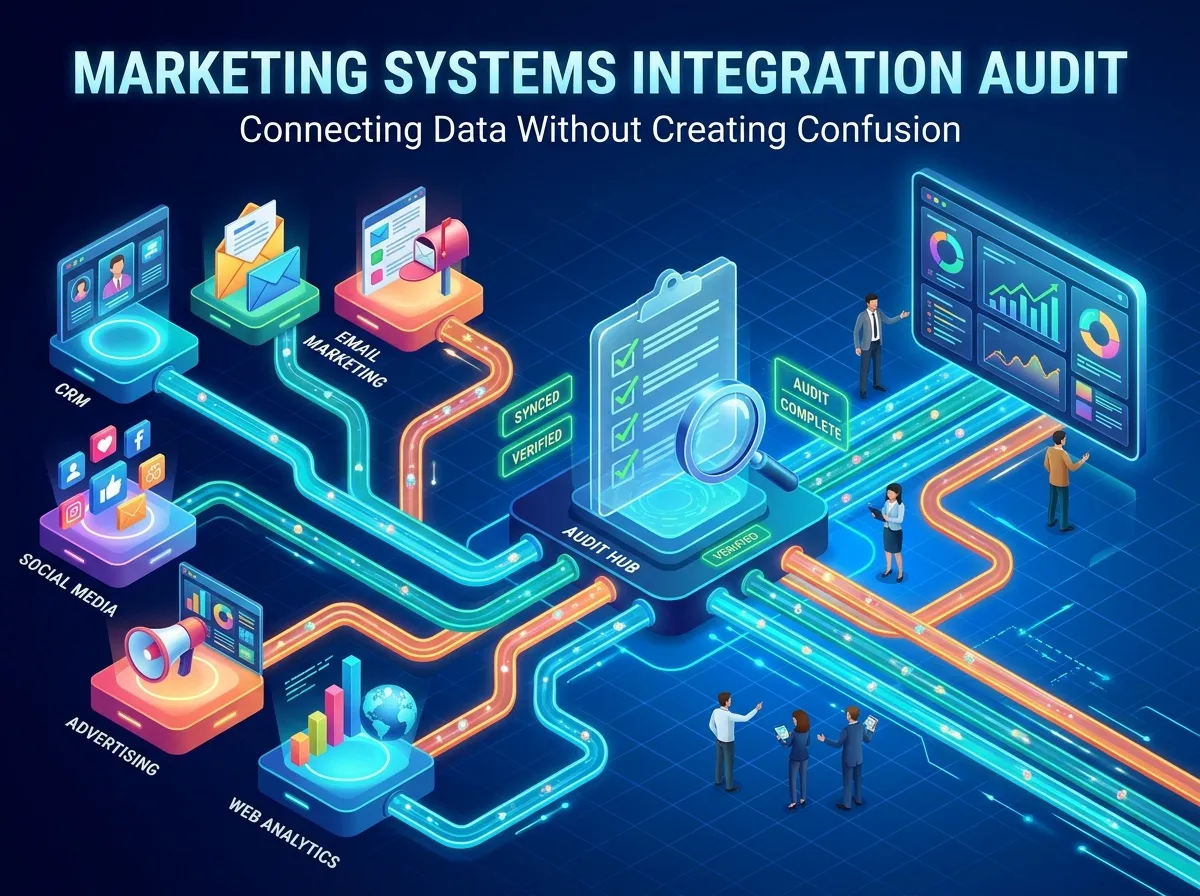
Marketing systems often operate across multiple platforms. Customer information may originate in a CRM, campaign engagement may be recorded in an automation platform, and conversion data may be stored in analytics software.
A Marketing Systems Integration Audit examines whether these systems exchange information accurately, consistently, and securely.
Integration problems can be difficult to identify because individual applications may appear to function correctly. The issue emerges when information moves between them.
A campaign may generate leads successfully, but the CRM might not receive the correct source information. A customer may update their preferences in one system while another continues using outdated data.
These inconsistencies affect reporting, segmentation, and communication quality.
The audit should examine data synchronization, field mapping, integration reliability, duplicate records, and the handling of failed transfers.
It should also consider whether integrations are still necessary. Some connections may have been created for temporary campaigns and no longer serve a useful purpose.
Reliable integration is not simply about connecting more applications. It is about ensuring that the right information reaches the right system at the right time.
Martech Stack Efficiency Analysis: Measuring the Value of Every Tool
A Martech Stack Efficiency Analysis looks at how well the entire collection of marketing technologies supports business performance.
Efficiency is not determined by the number of applications in a stack. A large technology environment can operate effectively when each tool has a clear purpose and well-defined responsibilities.
Likewise, a small stack can become inefficient if it lacks important capabilities or depends heavily on manual processes.
Efficiency analysis should examine the relationship between technology investment and operational outcomes.
Useful indicators may include:
- Software utilization and adoption
- Time spent on manual marketing tasks
- Campaign reporting accuracy
- Integration reliability
- Workflow completion rates
- Cost per supported marketing activity
- Employee productivity and satisfaction
These measurements provide a more balanced view than subscription costs alone.
For instance, a platform with a higher monthly fee may reduce the time required to prepare campaign reports. If that improvement allows employees to focus on strategy and execution, the platform may offer a stronger return than a cheaper alternative.
The analysis should connect technology performance with the activities that matter most to the organization.
Marketing Technology Gap Analysis and Future Business Needs
A Marketing Technology Gap Analysis identifies the difference between the capabilities an organization currently has and the capabilities it needs to achieve its future objectives.
This is particularly important when businesses expand into new markets, introduce additional products, or develop more sophisticated marketing programs.
A company may have reliable email automation but lack the ability to coordinate campaigns across several customer segments. Another organization may collect extensive engagement data but struggle to connect it with sales pipeline information.
These gaps can limit marketing effectiveness even when the existing technology is functioning properly.
The analysis should begin with business priorities. If the organization plans to improve customer retention, its technology may need stronger lifecycle reporting and segmentation capabilities. If it intends to expand account-based marketing, it may require better account intelligence and sales coordination.
The gap analysis then helps determine whether those needs can be addressed through existing tools, improved integrations, or new technology.
This approach prevents unnecessary purchases by ensuring that new investments are connected to clearly identified business requirements.
How Marketing Technology Audits Support Smarter Affiliate Operations

Affiliate marketing programs often depend on multiple systems for tracking links, managing partners, recording conversions, and evaluating performance.
As programs grow, the technology behind them can become increasingly complicated.
An audit can help identify whether affiliate tracking remains accurate, whether partner information is organized correctly, and whether reporting systems provide a consistent view of campaign results.
For example, businesses working with multiple referral partners may need to understand how sub-partners contribute to conversions. Sub Affiliate Tracking demonstrates the importance of monitoring partner-level performance within a broader affiliate structure.
Technology reviews can also help organizations identify reporting gaps, tracking inconsistencies, and unnecessary manual processes.
Affiliate programs may operate across different industries and audience segments. Exploring relevant Affiliate Marketing Niches can help businesses understand why tracking and technology requirements may vary according to the type of products, partners, and customers involved.
A well-organized technology environment makes it easier to manage these differences while maintaining reliable performance information.
Creating a Marketing Technology Environment That Can Grow
The long-term value of Marketing Technology Audits comes from making technology decisions more deliberate.
A successful audit does not end when unused applications are removed or integrations are repaired. It establishes a clearer understanding of how marketing systems should evolve as the business changes.
Organizations benefit from reviewing their technology environment regularly, particularly when new tools are introduced or major marketing processes are redesigned.
The review should encourage collaboration between marketing, sales, IT, finance, and data teams. Each department may understand a different part of the technology environment, and their combined knowledge helps prevent decisions that create problems elsewhere.
Marketing technology should remain flexible enough to support innovation while stable enough to protect important business processes.
Ultimately, a well-audited martech stack is not simply a collection of efficient applications. It is a connected business environment where information moves reliably, workflows support meaningful outcomes, and employees can focus on creating value rather than managing unnecessary complexity.
Frequently Asked Questions
1. What are Marketing Technology Audits?
Marketing Technology Audits are structured reviews of marketing software, systems, integrations, data, and workflows to determine whether they support business objectives effectively.
2. Why is a marketing tech stack audit important?
A marketing tech stack audit helps identify redundant tools, outdated systems, integration issues, and opportunities to improve efficiency and technology value.
3. What is included in a martech audit process?
A martech audit process typically reviews software usage, automation workflows, system integrations, data quality, reporting, security, and alignment with marketing goals.
4. How often should businesses conduct a marketing technology audit?
Businesses should review their marketing technology regularly, with a more comprehensive audit at least annually or whenever major changes occur in their marketing operations.
5. What is a marketing automation audit?
A marketing automation audit examines automated campaigns, triggers, customer journeys, workflows, and communication rules to ensure they remain accurate and relevant.
6. How does marketing technology optimization improve performance?
Marketing technology optimization improves system configuration, integration, usability, and resource allocation so that existing tools deliver greater operational value.
7. What is a marketing systems integration audit?
It evaluates how marketing applications exchange information, including data synchronization, field mapping, integration reliability, and record consistency.
8. What does martech stack efficiency analysis measure?
It measures how effectively marketing technology supports productivity, reporting accuracy, workflow performance, software utilization, and business outcomes.
9. What is marketing technology gap analysis?
Marketing technology gap analysis compares current system capabilities with the technology requirements needed to achieve future business and marketing objectives.
10. Can a marketing technology audit reduce software expenses?
Yes. An audit can identify unused subscriptions, overlapping applications, and inefficient processes. However, its main purpose is to improve overall technology value, not simply reduce costs.