
Sub Affiliate Tracking: Managing Partner Networks, Commissions, and Referral Performance

Sub Affiliate Tracking helps businesses manage multi-level affiliate relationships, monitor referrals, and calculate commissions accurately. Using specialized tracking software, companies can organize parent and sub-affiliate accounts, evaluate partner performance, manage promotional links, and improve commission attribution. Effective tracking also supports fraud prevention, transparent reporting, and better affiliate network management, helping businesses build scalable and reliable partnership programs.
Affiliate marketing has grown beyond simple partnerships between businesses and individual content creators. Many affiliate programs now operate through multiple layers of partnerships, where existing affiliates introduce new publishers, influencers, and promotional partners to expand their reach. This structure creates additional opportunities for revenue generation, but it also introduces challenges related to referral attribution, commission distribution, performance measurement, and partner management. Sub Affiliate Tracking helps businesses manage these relationships while maintaining accurate records of how referrals and commissions move through an affiliate network.
As affiliate programs become more complex, businesses need better visibility into the activities of their partners. Tracking only the primary affiliate is no longer sufficient when several sub-affiliates contribute to the same customer acquisition process. Companies must understand which partners generated referrals, how those referrals performed, and whether commissions are being assigned correctly.
An effective tracking system makes this process easier by connecting referral activities with the appropriate affiliate accounts. It provides businesses with a clearer understanding of their partnership structures and helps prevent confusion when multiple affiliates participate in promotional activities.
Beyond commission management, Sub Affiliate Tracking supports better decision-making. Businesses can identify productive partners, evaluate the quality of referrals, and understand which parts of their affiliate network contribute most to growth.
What Makes Sub Affiliate Tracking Different?
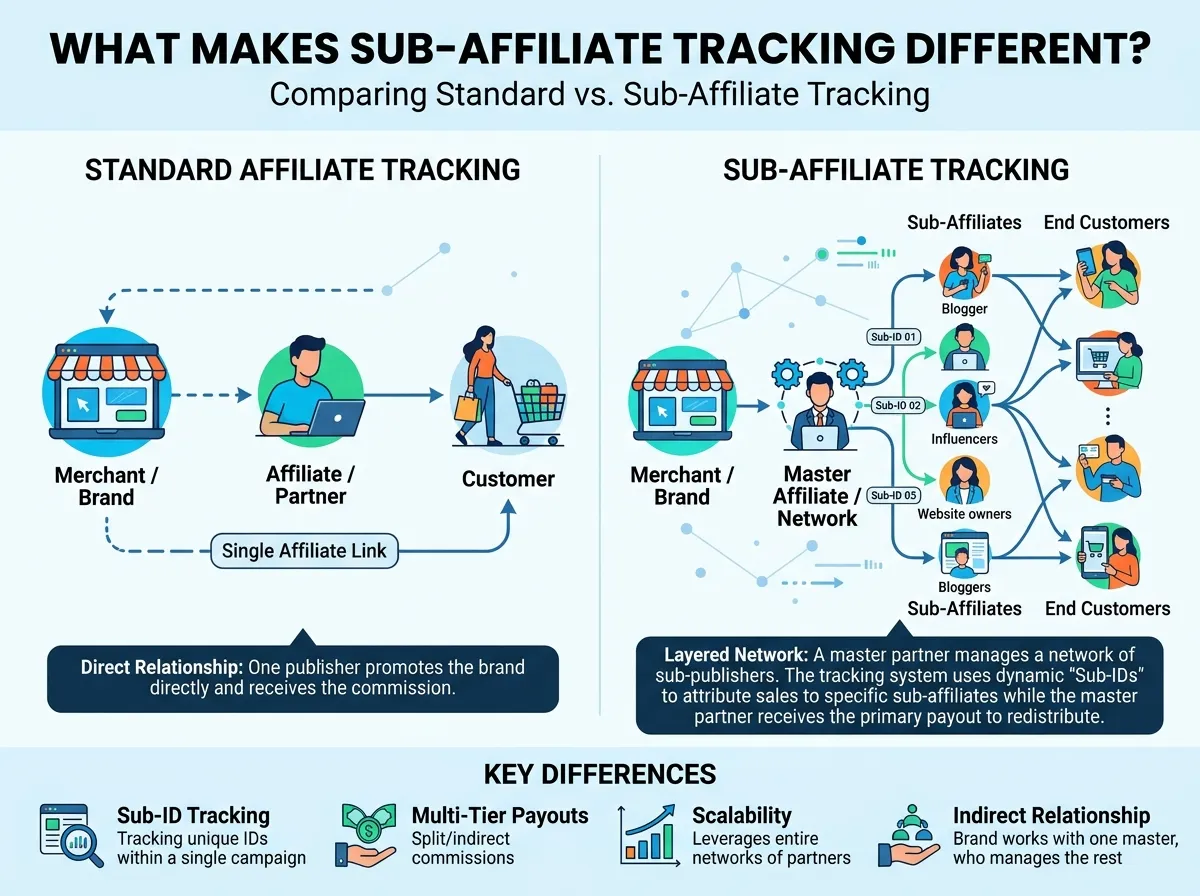
Traditional affiliate tracking usually connects a referral directly to the affiliate responsible for generating it. For example, a blogger promotes an online service using a unique referral link. When someone clicks the link and completes a qualifying purchase, the affiliate receives the agreed commission.
Sub Affiliate Tracking introduces another relationship into this structure. Instead of working exclusively with direct affiliates, businesses can allow existing affiliates to recruit or refer additional promotional partners.
Consider an affiliate who operates a marketing website and has an established audience of content creators. That affiliate may introduce several publishers to a company’s affiliate program. Those publishers then promote the company’s products and generate customer referrals.
The original affiliate becomes the parent affiliate, while the newly recruited publishers become sub-affiliates. Depending on the program’s rules, the parent affiliate may receive an additional commission based on the performance of their recruited partners.
This arrangement creates a more extensive partnership network. However, it also requires accurate tracking to distinguish direct referrals from sub-affiliate-generated conversions.
Sub Affiliate Tracking provides the structure needed to maintain these relationships and connect each qualifying transaction with the appropriate partner.
Why Businesses Need a Reliable Sub Affiliate Tracking System
Managing a small affiliate program manually may seem manageable at first. A business might use spreadsheets to record partner information, monitor referrals, and calculate commissions. However, these processes become increasingly complicated as the number of affiliates grows.
Imagine a company working with 50 primary affiliates, each recruiting another 10 publishers. The business now has hundreds of additional relationships to monitor. Every partner may generate different numbers of clicks, registrations, purchases, and qualifying conversions.
Without a structured tracking process, businesses can experience inaccurate commission calculations, duplicated referrals, incomplete reporting, and disagreements between partners.
A reliable Sub Affiliate Tracking system helps address these challenges by organizing affiliate relationships and maintaining records of referral activities.
It also provides greater visibility into network performance. Businesses can identify which parent affiliates recruit active partners and which sub-affiliates generate valuable customer activity.
Another important advantage is operational efficiency. Automated tracking reduces the administrative work associated with managing partner information and reviewing individual referral records.
For growing businesses, this becomes particularly valuable because the affiliate network can expand without requiring the same increase in manual management.
Understanding the Structure of Multi-Level Affiliate Tracking
Multi-Level Affiliate Tracking allows businesses to monitor relationships across multiple affiliate layers. Rather than treating every partner as an independent account, the system recognizes how affiliates are connected within the broader network.
For example, a company may establish a partnership structure consisting of a primary affiliate, several sub-affiliates, and individual promotional partners recruited through those relationships.
Each participant has a defined position within the network. The tracking system records these connections so that referral activities can be attributed to the appropriate accounts.
However, multi-level structures need clearly defined commission policies. Some programs reward only the parent affiliate when a recruited sub-affiliate generates a sale. Others may support multiple commission levels, provided the arrangement is permitted by applicable laws and the program’s commercial model.
Businesses should avoid creating unnecessarily complicated payment structures. The objective should be to reward genuine promotional activity rather than simply encourage additional recruitment.
A transparent hierarchy also helps partners understand how their relationships affect commission eligibility. When everyone knows how referrals are attributed and payments are calculated, disputes become less likely.
How Sub Affiliate Tracking Software Simplifies Partner Management
As affiliate networks grow, businesses often need specialized technology to manage their tracking requirements. Sub Affiliate Tracking Software provides tools for monitoring partner relationships, recording referral activities, and organizing commission information.
One important capability is affiliate hierarchy management. Administrators can view parent affiliates and their associated sub-affiliates, making it easier to understand how the network is structured.
Referral tracking is another essential feature. Software can assign unique tracking identifiers to affiliates and connect qualifying customer activities with the relevant referral sources.
Many platforms also provide commission management features. Businesses can establish different commission arrangements for parent affiliates and sub-affiliates according to their program policies.
Reporting functionality helps administrators evaluate partner performance without manually combining information from different sources.
Integration capabilities are equally important. A tracking platform may need to connect with ecommerce systems, payment processors, customer relationship management software, and marketing applications to maintain consistent transaction records.
When evaluating software, businesses should consider tracking accuracy, reporting flexibility, fraud prevention, data security, integration support, and the ability to accommodate future network growth.
The best solution is not necessarily the one with the largest number of features. It is the one that supports the organization’s actual affiliate structure without creating unnecessary complexity.
The Importance of Accurate Affiliate Referral Tracking
Affiliate Referral Tracking forms the foundation of a successful sub-affiliate program. If referral activities are not recorded accurately, businesses may struggle to determine which partners deserve credit for generating customer activity.
Unique affiliate links are commonly used to identify referral sources. These links contain tracking parameters or identifiers that associate website visits with particular affiliate accounts.
When a visitor clicks a referral link, the tracking system may record information such as the affiliate identifier, click timestamp, campaign details, and available attribution information.
If the visitor later completes a qualifying action, the system uses the program’s attribution rules to determine whether a commission should be awarded.
However, referral tracking involves more than recording clicks. Businesses must also account for cookie expiration, cross-device activity, repeated visits, duplicate conversions, and changes in attribution rules.
For example, a customer may initially visit a website through one affiliate link but return later through another promotional source. The program needs a clearly defined attribution model to determine which referral receives credit.
Accurate tracking therefore depends on both reliable technology and consistent program policies.
Managing Commissions Across Different Affiliate Levels
Commission management becomes more complicated when several partners participate in the same promotional network.
Sub Affiliate Commission Tracking helps businesses identify the commissions generated by individual sub-affiliates and determine whether parent affiliates qualify for additional earnings.
Consider an example where a parent affiliate recruits three publishers. Each publisher promotes a product and generates qualifying purchases. The system records the transactions under the relevant sub-affiliate accounts while applying the parent affiliate’s agreed commission arrangement.
The business can then review the direct commission earned by each publisher and any additional commission payable to the parent affiliate.
This distinction is important because different partners may have different payment agreements.
Commission policies should clearly explain:
-
The actions that qualify for commission payments.
-
The percentage or fixed amount assigned to each partner.
-
Whether parent affiliates receive additional earnings.
-
How refunds, cancellations, and chargebacks affect commissions.
-
When commissions become eligible for payment.
-
How disputes and attribution conflicts are handled.
Clear policies protect both the business and its partners. They also make financial reporting more reliable as the affiliate network expands.
Monitoring Affiliate Performance Beyond Referral Numbers
A large affiliate network does not automatically represent a successful one. Some partners may generate substantial traffic but very few conversions, while others may attract smaller audiences that consistently produce valuable customers.
Sub Affiliate Performance Monitoring helps businesses understand these differences.
Instead of focusing exclusively on clicks and registrations, companies can evaluate the quality of referrals generated by individual sub-affiliates.
Conversion rates provide one useful measurement. They indicate how effectively referred visitors complete desired actions, such as purchases, subscriptions, or registrations.
Revenue contribution offers another perspective. Businesses can compare the revenue generated by different partners to understand which relationships provide the greatest commercial value.
Customer quality is also important. A partner may generate many initial purchases but attract customers who frequently cancel subscriptions or request refunds. Another partner may generate fewer conversions but contribute customers with stronger long-term retention.
Monitoring these patterns helps businesses identify productive relationships and make more informed partnership decisions.
It also creates opportunities to improve underperforming partnerships. Companies can examine promotional methods, audience relevance, content quality, and referral patterns before deciding whether a partner needs additional support.
Building Better Affiliate Network Tracking
Affiliate Network Tracking becomes particularly important when businesses operate through several recruitment layers, promotional channels, and partner categories.
A well-organized network needs a consistent way to identify each affiliate and maintain the relationships between accounts.
For example, an ecommerce company may work with coupon publishers, product reviewers, bloggers, and social media creators. Some of these partners may independently join the program, while others may be introduced by existing affiliates.
The tracking system should distinguish these relationships without creating confusion about ownership or commission eligibility.
This is where network-level reporting becomes useful. Administrators can review the performance of an entire parent-affiliate group rather than evaluating every account separately.
They can also compare different partner categories to understand which recruitment channels contribute the most valuable affiliates.
For businesses using coupon-based promotional partnerships, tracking can help identify which publishers generate actual sales rather than simply attracting visitors looking for discounts. This connects naturally with Coupon Affiliate Marketing, where promotional incentives and publisher relationships play an important role in affiliate revenue generation.
A structured network also makes it easier to identify inactive partners, duplicated accounts, and unusual referral activity.
Organizing Sub Affiliate Links and Promotional Activities

Sub Affiliate Link Management is another important part of maintaining an effective partnership network.
Every affiliate needs a reliable way to access promotional links and understand which campaigns they are authorized to promote. When sub-affiliates operate through different websites, social platforms, and promotional channels, managing these links can become difficult.
A centralized system can help partners generate, organize, and monitor their referral URLs.
For example, a sub-affiliate promoting several products may need different links for product reviews, comparison articles, promotional landing pages, and seasonal campaigns.
Organized link management makes it easier to distinguish these activities and evaluate their performance.
Businesses should also ensure that tracking links remain functional and direct visitors to the correct destinations. Broken links, incorrect campaign identifiers, or outdated promotional URLs can result in lost referrals and inaccurate reporting.
Link transparency matters as well. Affiliates should follow applicable disclosure requirements and clearly communicate when content contains affiliate promotions.
Social platforms have become an important source of affiliate traffic, making link organization especially relevant for creators who promote products across multiple channels. Businesses exploring this promotional model can learn more through Social Media Affiliate Marketing.
Why Affiliate Commission Attribution Requires Clear Rules
Affiliate Commission Attribution determines how credit is assigned when different partners contribute to a conversion.
This becomes especially important in sub-affiliate programs because a customer may interact with several promotional sources before completing a purchase.
For instance, a customer may discover a product through a social media creator, read a review published by another affiliate, and eventually purchase through a coupon website.
Which partner receives credit?
The answer depends on the attribution model established by the affiliate program. Some programs use last-click attribution, while others may use first-click attribution or more customized rules.
Parent and sub-affiliate relationships introduce another consideration. A business may need to determine whether the parent affiliate receives an additional commission when a recruited sub-affiliate generates the qualifying conversion.
These rules should be documented before campaigns begin.
Tracking systems should also maintain sufficient transaction records to support commission reviews. This can include referral identifiers, conversion timestamps, order details, payment status, and applicable attribution information.
When attribution policies are clear, businesses can reduce disagreements and maintain greater confidence in their commission calculations.
Using Sub Affiliate Reporting Tools to Make Better Decisions
Data becomes valuable when businesses can understand what it reveals about their affiliate networks. Sub Affiliate Reporting Tools help turn referral and commission records into information that supports practical decisions.
Instead of reviewing individual transactions manually, administrators can examine performance reports that organize activity by affiliate, parent account, campaign, product, and promotional channel.
For example, a report may show that one parent affiliate has recruited 15 sub-affiliates, but only five regularly generate conversions. Another parent may have recruited fewer partners, yet those partners collectively contribute more revenue.
This information can help businesses evaluate recruitment quality rather than focusing only on network size.
Reports can also highlight commission distribution, conversion trends, refund rates, and inactive partnerships.
A useful reporting environment should make it possible to compare different time periods and identify changes in partner performance.
Businesses should also pay attention to unusual activity. Sudden increases in clicks without corresponding engagement, repeated transactions from suspicious sources, or unexpected referral patterns may require further investigation.
The purpose of reporting is not simply to measure activity. It is to help businesses understand how their affiliate relationships contribute to sustainable revenue.
Preventing Fraud and Maintaining Trust Across Affiliate Networks
As affiliate programs expand, protecting tracking accuracy becomes increasingly important. Fraudulent activity can distort performance reports, increase unnecessary commission expenses, and damage relationships between legitimate partners.
Some common risks include artificial clicks, fake registrations, cookie stuffing, misleading promotional practices, duplicate transactions, and unauthorized use of affiliate links.
A reliable Affiliate Partner Tracking System should provide mechanisms for identifying suspicious activities and reviewing questionable conversions.
For example, businesses can monitor unusual traffic patterns, compare click activity with conversion behavior, and investigate transactions that do not match expected customer activity.
Commission approval processes can also help prevent payments from being issued for invalid or reversed transactions.
However, fraud prevention should be balanced with fair treatment. Not every unusual traffic pattern indicates deliberate misconduct. Legitimate affiliates may experience sudden changes in performance because of seasonal promotions, viral content, or successful marketing campaigns.
Businesses should establish transparent investigation procedures and provide partners with a reasonable opportunity to clarify disputed activity.
Trust is an important part of affiliate relationships. Clear reporting, accurate payments, and consistent enforcement of program rules help maintain that trust over time.
The Future of Sub Affiliate Tracking

Affiliate marketing continues to evolve as businesses explore new promotional channels, creator partnerships, and performance-based revenue opportunities. Sub-affiliate networks are also becoming more diverse, creating greater demand for accurate tracking and better partner management. As consumer behavior changes, strategies such as Mastering Micro-Moment Marketing for Product Promotion can help businesses identify important customer interactions and deliver relevant promotional messages at the right time.
Artificial intelligence and advanced analytics may make affiliate tracking more intelligent by identifying unusual referral patterns, highlighting performance opportunities, and helping businesses evaluate partner quality.
Automated reporting can reduce administrative work, while improved integrations may connect affiliate tracking with ecommerce platforms, payment systems, and marketing applications.
Privacy developments will also influence how referral information is collected and processed. Businesses will need to pay greater attention to consent requirements, cookie restrictions, data retention, and transparent tracking practices.
Another important development is the growing emphasis on partnership quality. Businesses are increasingly interested in understanding whether affiliates attract relevant customers and generate sustainable revenue rather than simply expanding the number of registered partners.
This reflects a broader change in affiliate marketing. The future of successful programs will depend not only on recruitment but also on transparent relationships, reliable attribution, and meaningful performance measurement.
Conclusion
Sub Affiliate Tracking provides businesses with a structured way to manage complex affiliate relationships, monitor referrals, and distribute commissions across multiple partner levels. By combining accurate tracking technology with organized network management, companies can gain better visibility into their affiliate activities and understand which partnerships contribute meaningful results.
From commission attribution and link management to performance reporting and fraud prevention, every part of the tracking process plays a role in maintaining a reliable affiliate program.
Businesses should prioritize transparent commission policies, accurate referral records, and suitable tracking software as their networks expand. More importantly, they should evaluate partners based on the quality and value of their contributions.
When these elements work together, Sub Affiliate Tracking becomes more than a commission management solution. It becomes an important part of building accountable, scalable, and profitable affiliate partnerships.
10 Frequently Asked Questions About Sub Affiliate Tracking
1. What is Sub Affiliate Tracking?
Sub Affiliate Tracking is a system for monitoring referrals and commissions generated by affiliates recruited through existing affiliate partners. It helps businesses manage multiple partnership levels and accurately attribute qualifying conversions.
2. How does Sub Affiliate Tracking work?
It works by assigning unique tracking identifiers to affiliates and recording the relationships between parent affiliates and their sub-affiliates. When a qualifying conversion occurs, the system applies the program’s attribution and commission rules.
3. What is Sub Affiliate Tracking Software?
Sub Affiliate Tracking Software is a platform that helps businesses manage affiliate hierarchies, track referral activity, calculate commissions, and generate performance reports.
4. What is the difference between affiliate tracking and sub-affiliate tracking?
Traditional affiliate tracking monitors direct referrals from individual affiliates. Sub-affiliate tracking additionally monitors partners recruited by existing affiliates and records the relationships between them.
5. How does multi-level affiliate tracking manage commissions?
It uses predefined commission rules to calculate payments for different affiliate levels. Depending on the program structure, parent affiliates may receive additional commissions from qualifying sub-affiliate activity.
6. Why is affiliate commission attribution important?
Commission attribution determines which affiliate receives credit for a conversion. Clear attribution rules help prevent payment disputes and ensure commissions are distributed consistently.
7. What metrics should businesses monitor in a sub-affiliate network?
Businesses should monitor referral clicks, conversions, conversion rates, generated revenue, commission expenses, refund rates, active partners, and the overall quality of referred customers.
8. How can businesses prevent sub-affiliate tracking fraud?
They can use suspicious activity monitoring, conversion validation, duplicate transaction detection, commission approval processes, and regular reviews of unusual referral patterns.
9. Can small businesses use a sub-affiliate tracking system?
Yes. Small businesses can use sub-affiliate tracking to organize partner relationships, automate commission calculations, and expand their affiliate programs without relying entirely on manual records.
10. What should businesses look for in an affiliate partner tracking system?
Important features include accurate referral tracking, parent-child account management, flexible commission rules, reporting tools, fraud detection, security controls, and integration with existing business applications.